Leaving money on the table? Cash in your 2026 charging this year
Free money? Not quite: you are paid for your charging data via the ERE market. But if you charge at home, you can still claim 2026 retroactively. Here’s how.
By the ERE Team · Published September 23, 2026 · Last checked October 15, 2026 · 4 min read
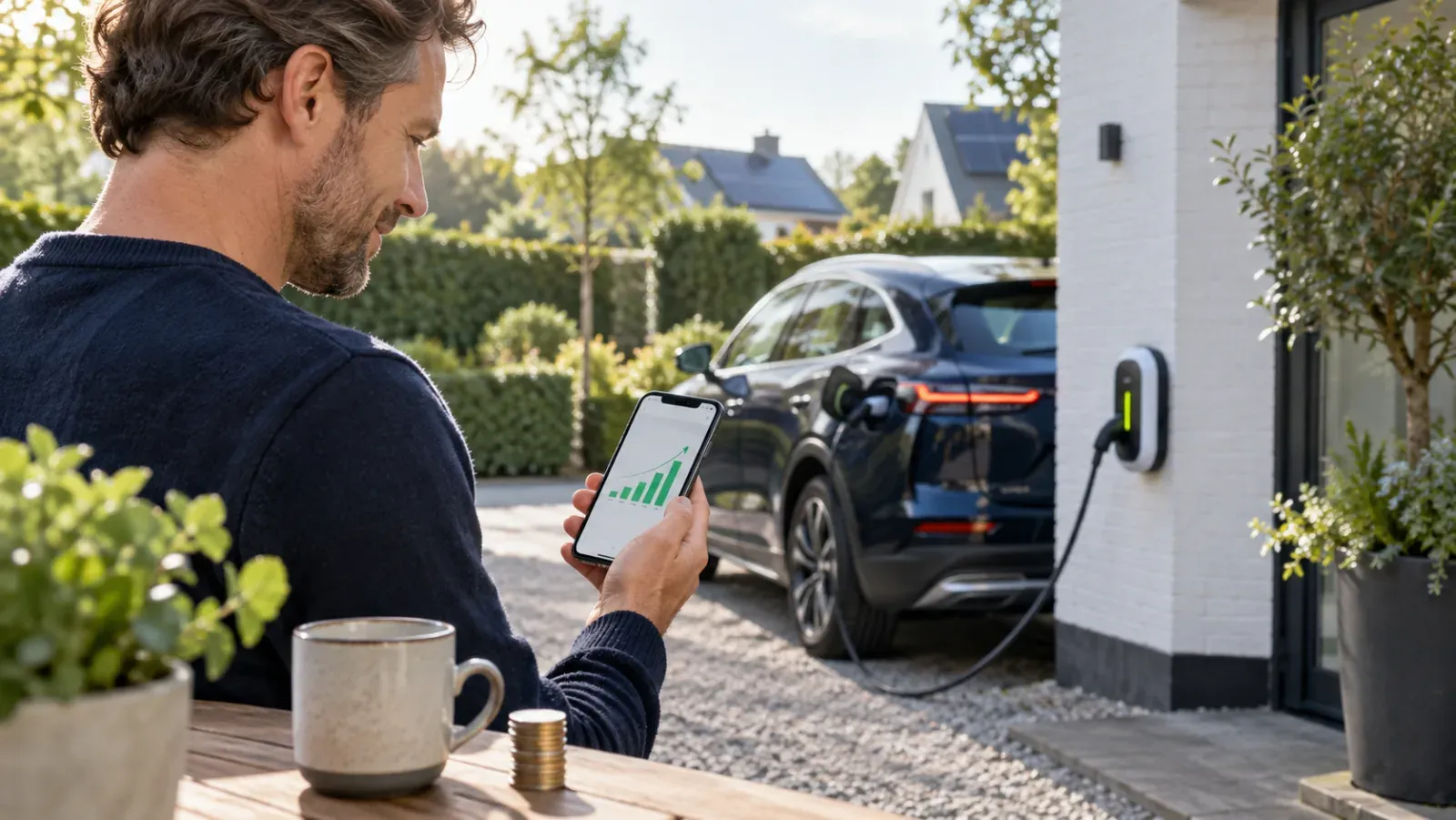
Hundreds of euros a year, just for charging your electric car at home. It sounds like free money - and if you haven’t signed up yet, you may be leaving that money for 2026 on the table. To be fair: it isn’t a subsidy or a gift. You get paid for your charging data. A registration service provider (inboekdienstverlener) records your charged kWh with the Dutch Emissions Authority (NEa) and sells the resulting emission reduction units (EREs) to fuel suppliers. You receive a share of the proceeds, depending on the market price and your provider. All amounts below are indications, not guarantees.
The good news: for 2026, you are probably not too late.
Do charging sessions from earlier this year still count?
In many cases, yes. According to the NEa, the mandate you give a registration service provider always covers one or more whole calendar years, each running from 1 January to 31 December. Providers such as Joulo, PowerD, Stekker and Zeres therefore state that sessions from 1 January 2026 count, even if you sign up later in the year.
There are conditions. Your charger needs a built-in, MID-certified kWh meter, and that meter must have measured the sessions at the time. Anything charged before the MID meter was installed does not count retroactively. Not sure about your charger? Run the charger check first.
Until when can 2026 still be booked?
The page Inboeken elektriciteit, read on 15 October 2026, says deliveries from a year can be booked until 1 March of the following year, that the verification statement must be in before 1 April, and that the year closes on 1 April. The step-by-step plan of 1 June 2026 names booking for 2026 through 26 February 2027. Those two timelines still stood side by side on 15 October 2026. The overview is under until when charging sessions of a year still count.
Note: that deadline applies to your provider, not to you. It needs time to collect and check your data, and sometimes sets an earlier cut-off. Joulo names 25 February 2027 as its last booking day; ERE-registratie says you must sign up before the end of 2026 to include the earlier months. Whether a sign-up in early 2027 still counts for 2026 differs per provider, and we cannot confirm it. To be sure, sign up this year.
So why have many not been paid yet? The renewed Register Energy for Transport (REV) opened on 17 August 2026 and is gaining features in stages. Booking electricity via registration service providers comes with ‘release 2’, expected mid-October 2026 according to the NEa planning; the NEa says that planning may still shift. Sessions from 2026 are then booked retroactively.
What do you need to sign up now?
- A charger with a built-in MID meter. For private individuals, the NEa requires it inside the charger itself.
- Your EAN code and IBAN. The grid connection must be in your name. An invoice for connection or grid costs can show the address, the EAN code and the name. For households that invoice often comes through the energy supplier. More on that is in Why you need your EAN code.
- Session data since 1 January, or since your MID meter was installed. The Inboekdienstverleners page says a photo or screenshot of a delivered volume alone is not sufficient. As an example the NEa names session registrations or invoices linked to the charger at the address. Without an automatic connection, ERE-registratie, for example, asks for start and end time, charger ID and kWh per session. See exporting charging sessions.
- No other provider for 2026. You may appoint only one registration service provider per calendar year, and switching mid-year is not possible; a different provider can only start on 1 January.
When will you see your money?
That differs widely. A selection from providers’ own information, in alphabetical order and checked on 23 September 2026 (Laadloon updated on 6 October 2026):
| Provider | Payout according to its own information |
|---|---|
| ERE-registratie | Quarterly with an automatic connection (first expected in Q4 2026), otherwise annually |
| Joulo | First payout expected in October 2026, after release 2 |
| Laadloon | By default in Q1 of the following year; with ‘Direct’ earlier, once the sale has been received (no fixed date) |
| PowerD | Immediately after the EREs have been traded and the money is in |
| Stekker | First payouts in Q1 2027 |
| Zeres | Quarterly; 50% advance for Q1 2026 paid on 6 July |
Sign up now, and in most cases expect a first payout at the end of 2026 or in 2027. On Which ERE provider has actually paid out? we track what is scheduled, stated and evidenced.
How much are you actually leaving behind?
In 2026, 1 kWh of home charging yields 0.33269 ERE; at 4,000 kWh a year that is just over 1,330 EREs. The median of named sources was €0.460 per ERE on 18 October 2026, within a range of €0.36 to €0.505. At €0.460 that is 1,330.76 × €0.460 ≈ €612 gross. After a commission of 15 to 25 percent, as at the providers we checked, you keep roughly €459 to €520 (€612.16 × 0.75 and €612.16 × 0.85). If the price moves, that amount moves with it. The Dutch government itself is more cautious, using 3,000 kWh at about €0.10 per kWh: around €300 a year, before the registration service provider’s costs. At the median above, the same 3,000 kWh comes to about €459 gross.
So not free money, but a real payment - and for 2026 only if someone books your sessions in time. Work out your situation with the earnings calculator and compare the providers on commission, payout and terms before you sign: the mandate covers the whole calendar year.
Frequently asked questions
Is the ERE payment really free money?
No. It is not a subsidy or a gift, but a payment for the EREs created from your registered charging data. Fuel suppliers buy those EREs to meet their legal obligation; the proceeds move with the market price, and your provider keeps a commission.
Can I still sign up now and get paid for 2026?
At the providers we checked, charging sessions from 1 January 2026 count, as long as your charger measured them with a built-in MID meter. The electricity page names booking until 1 March 2027 and year close on 1 April. The step-by-step plan of 1 June 2026 names 26 February 2027. Those two timelines still stood side by side on 15 October 2026. Providers sometimes set an earlier cut-off. So ideally, sign up before the end of 2026.
Do I need to sign up again for 2027?
That depends on your mandate. According to the NEa, it covers one or more whole calendar years, states its period of validity and may not be renewed tacitly. If your mandate only covers 2026, your provider needs a new one for 2027, even if your contract renews automatically. The turn of the year is also the only moment to switch provider.
Ready to compare providers?
Compare earnings, terms and service across every relevant ERE provider.
EREVergelijken.eu is independent: no provider pays for placement. The ranking follows a public methodology and includes all relevant providers.